Showing posts with label Get Around. Show all posts

Sunday, September 6, 2015

History of Chicago Expressways


Expressways have reshaped the Chicago region perhaps more than any other twentieth-century force, creating new business centers and dramatically expanding residential settlement.
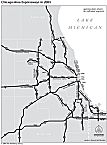
CHICAGO-AREA EXPRESSWAYS, 2003 (MAP)
Increasing automobile travel in the 1910s and 1920s gave new urgency to the arterial improvements recommended in the 1909 Plan of Chicago. In 1927, the Chicago Plan Commission laid out a system of limited-access highways radiating from theLoop, including a route along Avondale Avenue next to the Chicago & North Western Railway (the route later used for the Kennedy Expressway) that was defeated in a 1928 bond issue vote. Lakefront recreational improvements became subordinate to construction of Lake Shore Drive as a traffic-carrying parkway. Its limited access and diamond interchanges made the section from Belmont to Foster a forerunner of the urban freeway when it opened in 1933.
Although the Great Depression slowed urban growth and limited civic spending, auto use continued to grow and in 1940 the city council approved a system of superhighways radiating from downtown Chicago that is nearly identical to what was eventually built.World War II postponed all construction, but postwar growth soon made those improvements imperative. Long-distance traffic, particularly intercity trucks, presented the most pressing needs, and the Chicago area's first expressways were easy-to-build approaches to the urban area. The Kingery Highway (originally called the Tri-State Highway) opened in 1950 as part of a long-planned metropolitan bypass, and connected with the Bishop Ford Freeway (known as Calumet Expressway until 1996). Milwaukee-bound traffic was relieved with the opening of the Edens Expressway (now I-94) in 1951.
Urban expressways provided greater challenges. A West Side superhighway, heir to thePlan of Chicago's vision of a Congress Street arterial axis, had been tied to transit improvements with the creation in 1939 of the city's Department of Subways and Superhighways. Funding agreements between the city, county, and state finally fell into place in the late 1940s and construction began on the Eisenhower (originally Congress) Expressway, which opened in sections between 1955 and 1960. This project included construction of the north-south portion of Wacker Drive. Cook County Chairman Daniel Ryan engineered passage of a massive bond issue in 1955, expediting construction of other expressways.

Friday, July 3, 2015

Getting Around on the CTA Train


Traveling on the CTA is simple. You need to know what direction you need to go and what stop you need to get off on.  For example if you are down town and you want visit Oak Park Illinois to see the Frank Lyod Wright houses - using Moovit you will discover that you need to take the Green line to Harlem stop (the end of the line).  The final stop or direction is "Harlem".  If you are at the Adams station in downtown Chicago, you would climb the stairs marked Harlem which is on a Green background:


On the station platform stand near the sign marked Harlem with a green background:


Get on the train marked Harlem with a green background:


Inside the train you will see the stations announced. When the sign says "Harlem is next" it is time to get organized to leave the train:


Tuesday, February 10, 2015

Curfew in Chicago


Curfew in Chicago
  • Weekday curfew for minors 12 through 16 years of age is 10:00 p.m.;
  • Weekday curfew for minors under 12 is 8:30 p.m.;
  • Weekend curfew for minors 12 through 16 years of age is 11:00 p.m.;
  • Weekend curfew for minors under 12 is 9:00 p.m.

Violators are subject to a fine of up to $500 or community service, according to the mayor’s office. Three offenses in a twelve-month period shall be subject to up to $1,500 in addition to community service.

Saturday, January 31, 2015

Moovit - best way to travel


Moovit - Best way to get around Chicago

Use it in your language


We highly recommend that you download the Moovit app for either andriod or Iphone before you visit Chicago.  Moovit is the perfect app for your phone to help you find your way around the city using public transportation.  The app can be used in most languages.  By entering your address and where you want to go, the app will tell you step by step how to get there.  From which way to walk, where to get the bus, where to get the train (and what color train).  It can help you plan your trip. And best of all the app is free. So visit itunes or Google Play store and download Moovit today.